The Death of the Blue Link
For nearly three decades, the “Web” was a destination. We navigated it via gateways like Google, Bing, and Yahoo, clicking on a “ten blue links” result to visit a specific site. Software engineers spent their careers optimizing for the CTR (Click-Through Rate). But as we move through 2026, the traditional search engine is being replaced by the AI Synthesis Engine.
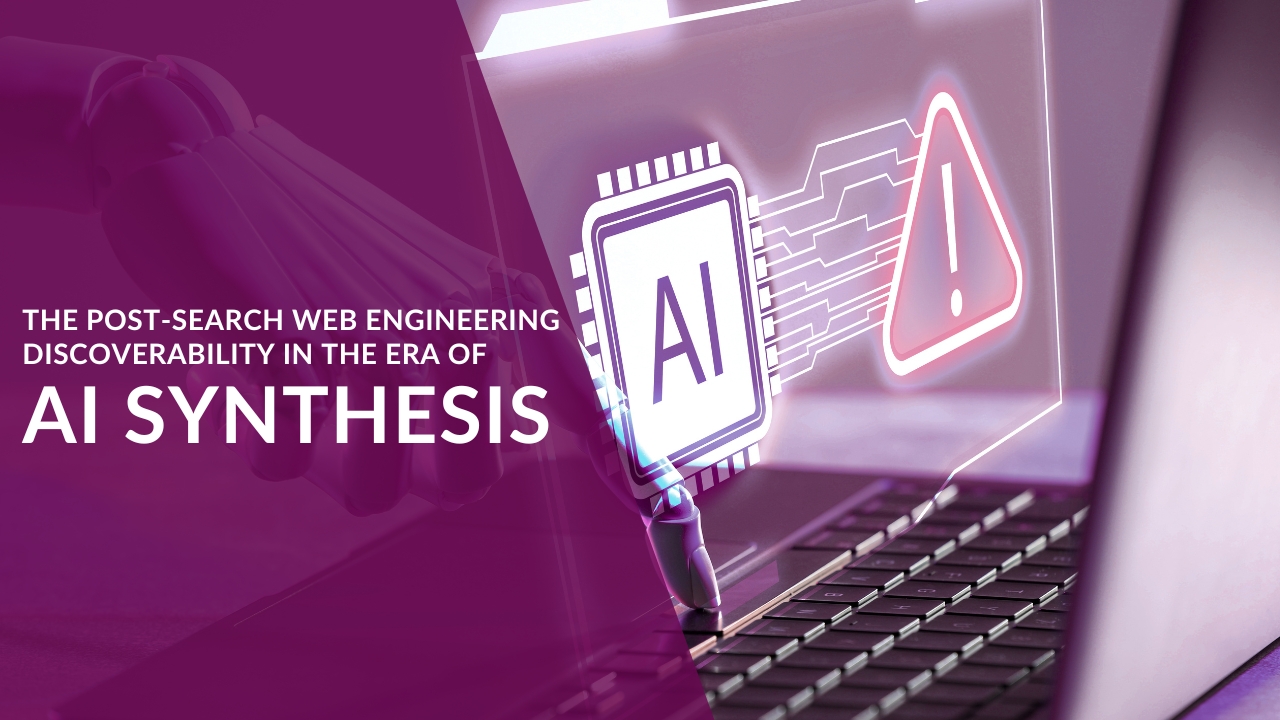
In this “Post-Search” reality, users no longer look for links; they look for answers. AI models crawl the web, ingest content, and synthesize a single, authoritative response directly on the search page or inside a chat interface. For developers and architects, this isn’t just a marketing shift—it’s a fundamental change in how we structure data, expose APIs, and define the value of our digital products. If the AI doesn’t “see” your content, your website—no matter how beautiful—ceases to exist.
1. From SEO to AEO (Answer Engine Optimization)
In 2026, the acronym SEO is being retired in favor of AEO: Answer Engine Optimization. The goal is no longer to rank #1 for a keyword; it is to be the Primary Source for an AI’s synthesis.
The Pillars of AEO:
- Truth-Density: AI models in 2026 are programmed to prioritize “Information Density.” Fluff-heavy, 2,000-word articles designed to game old algorithms are penalized. Models look for high-value “Truth Nuggets” that can be easily extracted.
- Citation Health: Answer engines value credibility. In 2026, being cited by other authoritative AI models or reputable peer-reviewed databases is the new “backlink.”
- Direct Address: Content is increasingly structured as “Q&A” blocks. Architects are using Micro-Frontends that serve specific, modular answers to LLM crawlers rather than full, heavy pages.
2. The API-First Content Model
In 2026, the “Website” is increasingly becoming a secondary asset. The primary asset is your Structured Data Stream.
The Headless Transition: Architects are moving toward a “Headless Everything” approach. Your content is no longer just HTML; it is a live JSON-LD (Linked Data) stream optimized for machine consumption.
- Semantic Schema 2026: We are using advanced Schema.org vocabularies that describe not just “Products” or “Articles,” but “Relationships,” “Arguments,” and “Intent.”
- LLM-Readiness: Servers in 2026 now detect if the “User Agent” is a human or an AI Crawler. If it’s an AI, the server delivers a high-speed, markdown-formatted summary of the page’s core logic, bypassing the CSS and JavaScript entirely to save compute and improve synthesis speed.
3. The Verification Layer: Fighting AI Hallucination
One of the biggest challenges of 2026 is Verification. How does an AI know that your content is true? As the web becomes flooded with synthetic content, human-verified “Proof of Origin” is the new gold standard.
Technical Trust Signals:
- Content Credentials (C2PA): Software architects are implementing cryptographic signatures on all published data. This proves the content was created by a specific, verified entity and hasn’t been altered by malicious AI.
- Knowledge Graph Integration: Instead of hoping an AI finds your site, engineers are “pushing” data directly into decentralized Knowledge Graphs. This ensures your brand’s facts are hard-coded into the AI’s training set rather than being inferred.
4. Conversational UX and the “Invisible” Website
In the Post-Search web, the user interface is often a voice or a chat bubble. This means the “User Journey” is no longer linear.
The Intent-Driven Architecture:
- Predictive Prefetching: Based on a conversation, the backend predicts the next three likely questions and “warms up” the data.
- Dynamic Component Injection: Instead of a static page, the AI “pulls” specific UI components from your server—like a calculator or a booking widget—and embeds them directly into its own chat interface.
- The Death of the Landing Page: In 2026, the “Landing Page” is whatever the AI decides to show. Architects must ensure that every micro-component of their site is “Self-Sufficient”—containing all the branding and trust signals needed to function in isolation.
5. Monetization in a Zero-Click World
The most pressing question for businesses in 2026 is: “If no one clicks on my site, how do I make money?”
The 2026 Revenue Pivot:
- Brand-as-a-Service: If an AI uses your data to solve a problem, the AI provider pays a micro-royalty. This is the Data Licensing Model.
- Value-Added Conversions: Companies are focusing on “Deep Actions”—things an AI can’t do, like a physical consultation, a specialized software integration, or a community experience.
- The “Source of Truth” Subscription: Providing “Verified Data” feeds that AI engines pay to access, ensuring their answers are accurate and up-to-date.
6. Conclusion: The Engineer as the Information Architect
The Post-Search web isn’t an end; it’s an evolution. It requires us to move beyond “Web Development” and into Information Architecture.
In 2026, we are no longer just building walls (websites) and hoping people walk through the door. We are building the Foundation of Truth that the world’s AI relies on. The successful engineer of this era is the one who understands that in a world of infinite synthetic noise, Structured, Verified, and Accessible Truth is the most valuable commodity on Earth.
The blue link may be dying, but the power of the Answer has never been greater.